Showing posts with label commercial art. Show all posts

Sunday, January 31, 2010

Maurits Cornelis Escher (1898 - 1972)


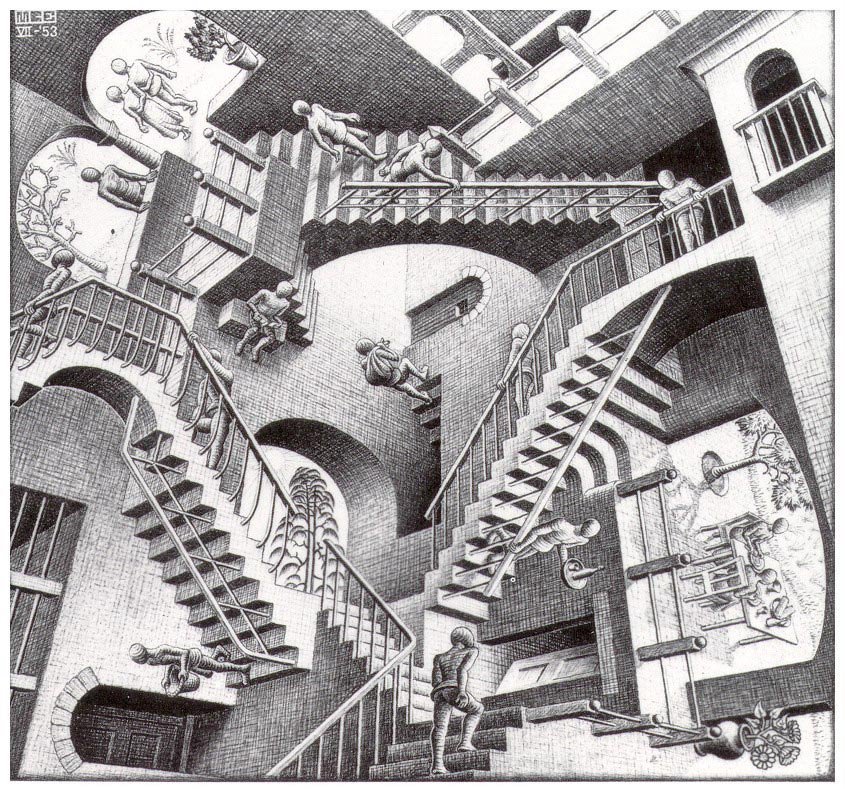
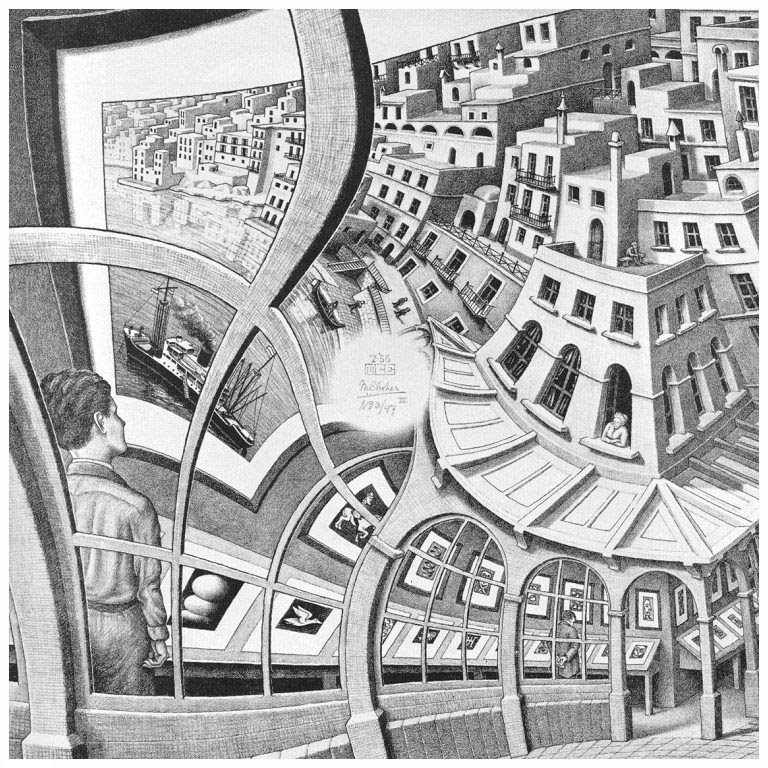
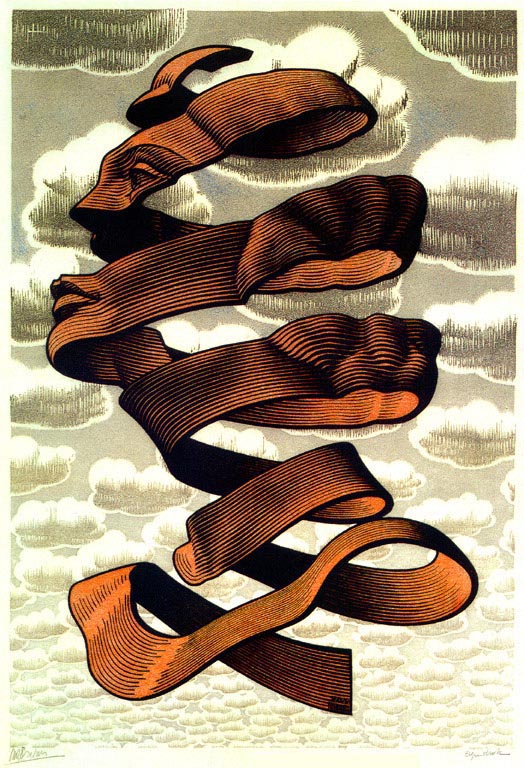
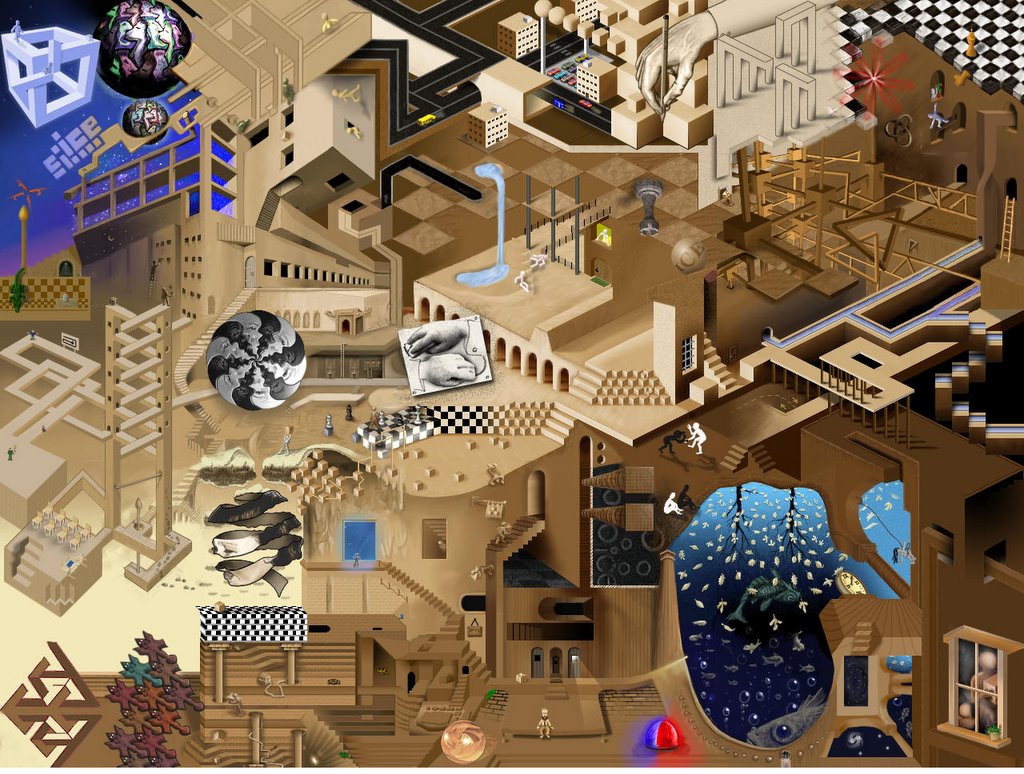
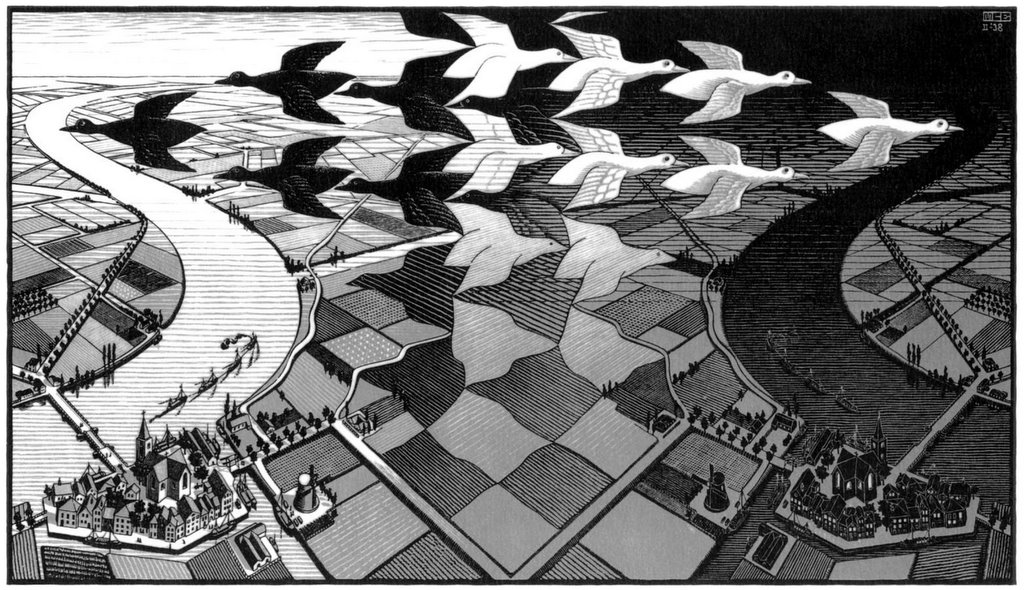
Maurits Cornelis Escher (1898-1972) is one of the world's most famous graphic artists. His art is enjoyed by millions of people all over the world, as can be seen on the many web sites on the internet.He is most famous for his so-called impossible structures, such as Ascending and Descending, Relativity, his Transformation Prints, such as Metamorphosis I, Metamorphosis II and Metamorphosis III, Sky & Water I or Reptiles.

M.C. Escher, during his lifetime, made 448 lithographs, woodcuts and wood engravings and over 2000 drawings and sketches. Like some of his famous predecessors, - Michelangelo, Leonardo da Vinci, Dürer and Holbein-, M.C. Escher was left-handed.Apart from being a graphic artist, M.C. Escher illustrated books, designed tapestries, postage stamps and murals. He was born in Leeuwarden, the Netherlands, as the fourth and youngest son of a civil engineer. After 5 years the family moved to Arnhem where Escher spent most of his youth. After failing his high school exams, Maurits ultimately was enrolled in the School for Architecture and Decorative Arts in Haarlem.

After only one week, he informed his father that he would rather study graphic art instead of architecture, as he had shown his drawings and linoleum cuts to his graphic teacher Samuel Jessurun de Mesquita, who encouraged him to continue with graphic arts.After finishing school, he traveled extensively through Italy, where he met his wife Jetta Umiker, whom he married in 1924. They settled in Rome, where they stayed until 1935. During these 11 years, Escher would travel each year throughout Italy, drawing and sketching for the various prints he would make when he returned home.

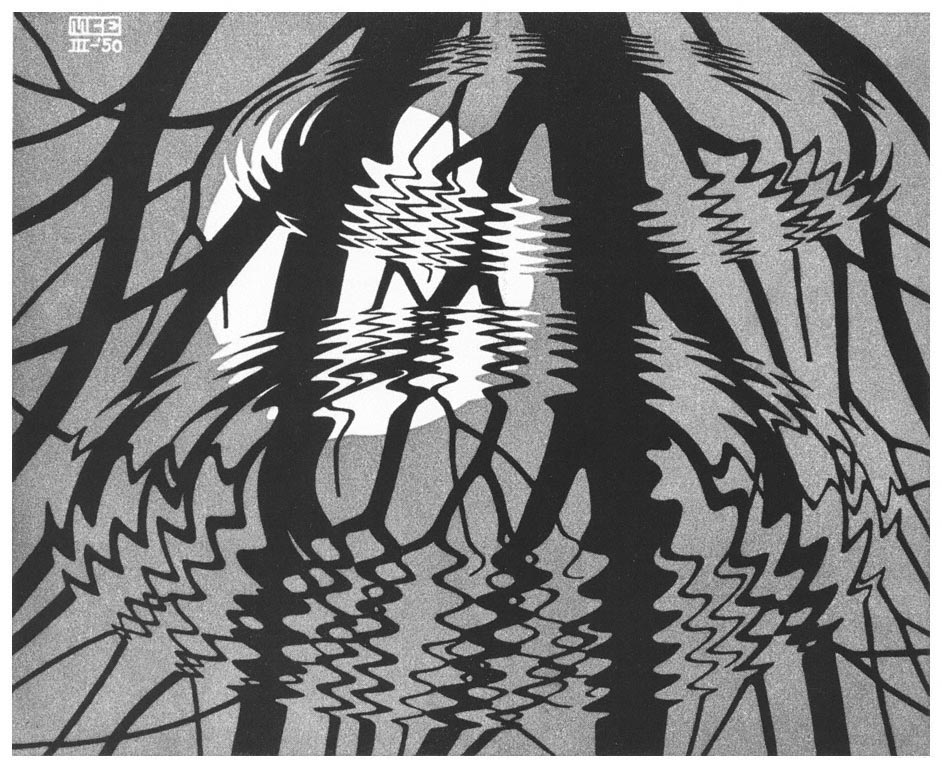
Many of these sketches he would later use for various other lithographs and/or woodcuts and wood engravings, for example the background in the lithograph Waterfall stems from his Italian period, or the trees reflecting in the woodcut Puddle, which are the same trees Escher used in his woodcut "Pineta of Calvi", which he made in 1932.

M.C. Escher became fascinated by the regular Division of the Plane, when he first visited the Alhambra, a fourteen century Moorish castle in Granada, Spain in 1922.During the years in Switzerland and throughout the Second World War, he vigorously pursued his hobby, by drawing 62 of the total of 137 Regular Division Drawings he would make in his lifetime.He would extend his passion for the Regular Division of the Plane, by using some of his drawings as the basis for yet another hobby, carving beech wood spheres.He played with architecture, perspective and impossible spaces. His art continues to amaze and wonder millions of people all over the world. In his work we recognize his keen observation of the world around us and the expressions of his own fantasies. M.C. Escher shows us that reality is wondrous, comprehensible and fascinating.

Doglas Hofstadter, in his Pulitzer Prize-winning book :Gödel, Escher, Bach: an Eternal Golden Braid says that following about Escher :"I realized that to me, Gödel and Escher and Bach were only shadows cast in different directions by some central solid essence. I tried to reconstruct the central object, and came up with this book."

There is an Escher Museum in Netherlands as well as many permanent collections devoted to Escher including one at the National Gallery of Art.


\


The Official M.C. Escher Website

Saturday, July 19, 2008

'An Obsessive Compulsion towards the Spectacular'

SPIEGEL ONLINE
07/18/2008

Dutch architect Rem Koolhaas talks about new trends in architecture and urban development, the end of the European city, the rise of Dubai, Russia and China, the obsession with XXXL and the difference between the people who design buildings for a living and "star architects."

Rem Koolhaas's CCTV Tower in Beijing: "It looks different from every angle."
AFP

Rem Koolhaas's CCTV Tower in Beijing: "It looks different from every angle."

SPIEGEL: Mr. Koolhaas, you are designing buildings in Europe, the United States, the Persian Gulf and China. From which part of the world do you expect to see the strongest impulses for architecture and urban development emerging in the future?

Koolhaas: We have to draw some distinctions here. As far as the experience of building goes, the strongest impulse will undoubtedly come from China and the Middle East, and probably from India, as well. Things get more complex when it comes to thinking. The intellectual force of the West is still dominant, but other cultures are getting stronger. I expect that we will develop a new way of thinking in architecture and urban planning, and that less will be based on our models. There are many young, good architects in China. The unanswered question is whether our cooperation, this internationalization, will result in a common language of architecture, whether we will speak two different languages or whether there will be a mixture of the two.

SPIEGEL: At a recent talk in Dubai, you showed two slides. The first image was of a series of iconic skyscrapers that you, Zaha Hadid and other star architects designed. The second was of a collection of high-rise buildings designed by unknown architects. The images were surprisingly similar.


To see the photo gallery click on the picture:

http://www.spiegel.de/img/0,1020,1224525,00.jpg

Koolhaas: I have a very hard time with the expression "star architect." It gives the impression of referring to people with no heart, egomaniacs who are constantly doing their thing, completely divorced from any context. I believe that this is a grotesque insult to members of a profession who -- to the extent that I know my colleagues -- go to great lengths to find the right thing, the appropriate thing, for each individual case. At the same time we are, of course, driven by the market -- and by developers who try to pin us down to certain forms. I have spent a lot of time thinking about the best way for us to escape this being pinned down to the purely formal. That's why I decided to simply demonstrate it: There is, in fact, no great difference between the buildings by "star architects" and those designed by others.


SPIEGEL: When you work on large projects, how much time do you have to engage with a place, a specific context? In Dubai, you recently designed, in the space of only one year, a city for 1.5 million people, known as Waterfront City.

Koolhaas: There is less time available for research, so that a tendency toward imitation develops. One of our theories is that one can offset this excessive compulsion toward the spectacular with a return to simplicity. That's one effect of speed. Another one is the now universal demand for everything to be "sustainable." We have been interested in this idea since the 1960s, so in that respect we feel vindicated. But now sustainability is such a political category that it's getting more and more difficult to think about it in a serious way. Sustainability has become an ornament. Designs are increasingly winning competitions because they are literally green, and because somewhere they feature a small windmill.

SPIEGEL: You apparently don't like the concept of sustainability ..............

Read more

Thursday, October 13, 2005

A gallery of Lovecraft book covers


It's kind of touching to see such a host of graphic artists valiantly struggling to capture this author's impossible sensibility within their own limits of time and budget constraints. Plus, supposedly, some shopper is supposed to buy that thing off a shelf! I wonder how many of these packages would have attracted Lovecraft's own interest as an inveterate book browser. Some of them, for sure. Maybe about one in ten. Also check out this page from a devoted fan.

SYSTAIME "10H17"


FRENCH TRASH TOUCH SYSTAIME.comMichael Borras aka SYSTAIME.com, creator of " French Trash Touch ” got his national superior diploma of plastic expression and he works in Paris . As painter, performer and video-installation artist, he has developed various creative activities and he is concentrating on net-art and creation of web-films. Focusing on subversionof conventional media discourse, incrustation and double exposure of images have at the same time, softness/violence and fascination/repugnance. His original works have been presented in Perspective

Monday, June 13, 2005

See the Grammatron


"GRAMMATRON is grappling with the idea of spirituality in the electronic age." The New York Times
"A colosssal hypertext hydrogen bomb dropped on the literary landscape..." Time-Warner's Pathfinder
"A rollercoaster ride through textspace...click to enter GRAMMATRON and you're pulled into a machine eye's view of both storytelling and story theory...intense."MSNBC's The Site
"Amerika's work exemplifies how online literary creations are developing into an entire multi-media experience...hypertext works like GRAMMATRON are far a few between." Wired
"...the first major Internet-published work of fiction to produce an experience unique to the medium."The Village Voice
"The end of postmodernism andthe beginning of Avant-Pop."Die Zeit
"The world's most ambitious cybernovel."The Australian

http://www.grammatron.com/index2.html