Showing posts with label latin america. Show all posts
Showing posts with label latin america. Show all posts
Friday, April 10, 2009

Saturday, July 1, 2006
The Rebel and Mr. Danger
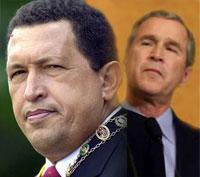
Is Bush’s nightmare Venezuela’s salvation?
Greg Grandin, Boston Review
There is something quaint—flattering, even—about the way Venezuelan President Hugo Chávez insists on calling George W. Bush “Mr. Danger.” The taunt, which Chávez delivers in English with rolled-out vowels and pinched consonants, evokes an earlier era of cloak-and-dagger politics and lends Bush a certain mystery that he is generally denied in these shrill times of stateless terrorism. Mr. Danger, it turns out, is a minor character in Rómulo Gallegos’s 1929 novel Doña Barbara, a landmark in Venezuelan literature and before the fiction boom of the 1970s one of the most widely read Latin American novels in the world. A “great mass of muscles under red skin, with a pair of very blue eyes,” he is one of many unsympathetic misters who populate 20th-century Latin American social and magical realist prose, beginning in 1904 with the Chilean writer Baldomero Lillo’s abusive mine foreman Mr. Davis and continuing through Mr. Brown, the manager of a U.S. banana company in Gabriel García Márquez’s One Hundred Years of Solitude.
In Doña Barbara, the inhabitants of Venezuela’s untamed southern plains at first welcome the arrival of Mr. Danger, believing that he will bring “new ideas” to help modernize the region’s agricultural production. Their hopes are quickly dashed as the “scornful foreigner” loafs in his hammock, smoking his pipe and living off rustled cattle, stirring only to shoot alligators and ply his neighbor with liquor to steal his property and despoil his daughter. Mr. Danger is a “humorist in his own way” who, when introducing himself, repeats his surname in Spanish— peligro—“to emphasize its disconcerting translation.” It’s a trick Chávez, also easy with a joke, likewise enjoys: “The greatest peligro in the world,” he warns, “is Mr. Danger.” Gallegos himself served as Venezuela’s president ...for less then a year in 1948 before being ousted in a coup that many Venezuelans insist had the support of Standard Oil and the U.S. embassy. So for the millions reared on the novel Chávez’s own disconcerting translation has special force.
Chávez’s success owes much to his creation of a colloquial cosmopolitan nationalism, his ability to thread into his speeches historical figures such as Simón Bolívar and literary references more obscure than Mr. Danger. As his international stature and aspirations have increased, Chávez has expanded his repertoire. He now moves seamlessly from Simón Bolívar to Jawaharlal Nehru, Bertrand Russell to Noam Chomsky. But Mr. Danger has only a bit part in Doña Barbara, which is concerned less with vanquishing the imperial interloper than with taming Venezuela’s inner demons. The novel follows the progress of Santos Luzardo, beginning with his return from Caracas to his ancestral ranch deep in Venezuela’s mythic llano country. Urbane and lettered, Luzardo at first hopes to sell his inheritance but soon succumbs to the call of the land. Gallegos leaves little to the imagination. Santos Luzardo, a lawyer whose name means Sacred Light, slowly gains the advantage in a war of maneuver with his neighbor, Doña Barbara, an enchantress whose impulsive power over men symbolizes all that the interior of the nation, and thus the nation itself, must overcome if it is to move forward: hierarchy maintained by arbitrary clientalism; profit derived from theft rather than production; and society held together by fear in lieu of law.
For those familiar with Doña Barbara, it might seem odd that Chávez, in invoking Mr. Danger, implicitly identifies with Luzardo, whose struggle to civilize the plains was represented by his installation of a barbed-wire fence around his vast ranch. Chávez, after all, has done more than any of his center-left counterparts who now govern throughout Latin America to weaken the absolute right of private property that has been the cornerstone of the global political economy for more than two decades. He has distributed large, unproductive public lands and private estates to peasant cooperatives, nationalized bankrupted industries, and forced oil multinationals to renegotiate operating contracts. But Chávez easily updates the values that mark Doña Barbara’s barbarism to lambaste “cruel and savage” free-market capitalism. And like Luzardo, who triumphs by putting his enemies’ weapons to his own use, Chávez, a former coup plotter and self-described revolutionary, has bested his opponents at their own electoral game.
* * *
Since the end of the Cold War, the United States has moved away from its traditional reliance on military strongmen in Latin America, instead staking its future on the promotion of unregulated markets and constitutional democracies. It has turned out to be an explosive combination. Decades of financial liberalization, tight money, and open markets, along with the rampant corruption that took place with the selling off of state industries, have bejeweled the few while leaving the rest ragged. During the first five years of this decade the region’s economy grew by one point, and during the previous decade it grew by only nine points. In contrast, the heyday of state developmentalism, between 1960 and 1980, produced 82 percent growth. Today, over 213 million of Latin America’s 520 million people live in poverty, 88 million of them in extreme poverty. Provoked mostly by this social catastrophe but also by Bush’s post-9/11 embrace of unilateral militarism, voters in Venezuela, Brazil, Uruguay, Argentina, and Bolivia have in recent years elected presidents sharply critical of Washington, a trend that may continue in July when Mexicans go to the polls. But these new leftists, constrained by free-trade treaties, autonomous central banks, and the fickleness of financial markets, have mostly opted to pursue mild reform while leaving unchallenged the assumptions of export-led market development. Even Bolivia’s Evo Morales, who came to power promising to be Washington’s “nightmare,” conceded just before his election that in office his hands would be tied by “20 years of neoliberal laws.”
It was Venezuela that provided the prototype for this kind of top-down, restricted democracy. After a decade-long dictatorship ended in 1958, the formalities of democratic rule were maintained for 40 years as power rotated between two ideologically indistinguishable parties: Acción Democrática and the Comité de Organización Política Electoral Independiente. By the early 1980s, the country had enjoyed such a long period of stability that it was celebrated by the U.S. State Department and its allied policy intellectuals, among them Samuel Huntington, as the “only trail to a democratic future for developing societies . . . a textbook case of step-by-step progress.” In hindsight, its institutions were rotting from the inside out. Every sin that Chávez is today accused by his opponents of committing—governing without accountability, marginalizing the opposition, appointing partisan supporters to the judiciary, and dominating labor unions, professional organizations, and civil society—flourished in a system described by the political scientist Michael Coppedge as “partyarchy.” This arrangement solidified during the flush years of high oil prices, with export revenue funding an enormous patronage trough, including graft and kickbacks for political and business elites and what was hailed as a showcase welfare system for everyone else. Absolute poverty and inequality did decrease somewhat in the 1970s, less a result of government programs than a massive march of migrants in search of industrial wages escaping to either Caracas or one of the country’s provincial towns organized around oil drilling, refining, and shipping.
But petroleum prices began to fall in the mid-1980s. By this point, Venezuela had grown lopsidedly urban, with 16 million of its 19 million citizens living in cities, well over half of them below the poverty line. Between 1981 and 1997, the share in national income of the poorest two fifths of the population fell from 19.1 to 14.7 percent while the share of the wealthiest tenth increased from 21.8 to 32.8 percent. During roughly this same period, the percentage of those living in extreme poverty tripled, from 11 to 36 percent. Throughout the 1980s, Caracas grew at a galloping pace, creating combustible concentrations of poor people cut off from municipal services—such as sanitation and safe drinking water—and hence party control. The spark came in February 1989, when AD’s recently inaugurated president Carlos Andrés Pérez, who had rallied against the IMF during his campaign, announced that he had no choice but to submit to its dictates, which included abolishing food and fuel subsidies, increasing gas prices, privatizing state industries, and cutting spending on health care and education.
Three days of rioting and looting spread through the capital following Pérez’s announcement. The Caracazo, as the uprising became known, heralded both the beginning of the hemisphere’s increasingly focused opposition to free-market absolutism and the end of Venezuela’s exemption from the pitched cycles of radicalism and reaction that had overtaken most of its neighbors during the Cold War. Established parties, unions, and government institutions proved entirely incapable of restoring legitimacy in austere times, committed as they were to not challenging a profoundly unequal class structure. The military, which remained relatively respected during the declining years of AD-COPEI rule, was torn apart, having killed (according to some observers) over a thousand people to restore order. Hugo Chávez emerged from this ruin: leading a group of young officers, many of them educated in civilian universities and untutored in U.S. counterinsurgency doctrine, who were committed to a broad and vague program that rejected free-trade austerity, he repudiated the country’s unresponsive and corrupt political system and sought to restore the prestige of the armed forces.
Chávez’s fearsome political skills—his ability to bob and weave and keep his opponents off-balance—contributes to the sense that he has no political program beyond responding to exigencies. Yet for a decade before the Caracazo, Chávez had patiently built ties between his fellow young cadets and civilian reformers, excavating embryonic concerns about economic justice, racial inclusion, and social solidarity within Venezuelan nationalism and fusing them to the leftist political alliances that emerged in the wake of Venezuela’s failed insurgency of the 1960s and breakup of the Communist Party.
By the time he burst onto the national scene with his 1992 coup attempt, he had secured at least the tacit endorsement of much of the country’s true opposition, those activists and parties cut out of the AD-COPEI duopoly. During the six years between the aborted coup and the 1998 elections, two of which Chávez spent in jail, the wildfire spread of his putschist-turned-electoral movement was fanned by more than a would-be caudillo’s magnetic appeal to an amorphous mass. Venezuela—like other countries in the region—witnessed the emergence of independent grass-roots organizations not dependent on party patronage, including neighborhood councils; feminist, economic-justice, and human-rights groups; environmental coalitions; and breakaway unions. Chávez’s 1998 presidential candidacy provided a focal point for this diffuse civil society, at first more metaphorical than institutional. Sixty-seven percent of Venezuelans are considered mestizos, ten percent black, 21 percent white, and two percent indigenous, a racial distribution that largely corresponds to the class distribution. The esteem in which Chávez is held by the dark-skinned poor is amplified by the rage the Venezuelan president provokes among the white and the rich, a distinction that has destroyed the country’s myth of racial democracy as thoroughly as it has its sense of political exceptionalism.
Winning the presidency in 1998 with 56 percent of the vote, Chávez at first seemed to be following the path blazed by Alberto Fujimori in Peru, who harnessed the electorate’s anger to strengthen the executive branch at the expense of the congress and the judiciary. Shortly after his inauguration in early 1999, Chávez launched a series of votes that resulted in the ratification of a new constitution and the replacement of a bicameral legislature with a unicameral one. In July 2000, 6,000 political offices, from community posts to the presidency, were put to a vote under the terms of the new charter. Chávez was reelected, and his supporters won a majority in the new legislature and 15 out of 23 state governorships.
But the experience of Peru under Fujimori was fundamentally different. The former Peruvian president came out of nowhere, with no social base or political tradition to build on, leading him to rely on the services of his deadly intelligence director Vladimiro Lenin Montesinos and to implement economic policies favored by Wall Street and Washington. Chávez, in contrast, had spent decades building relations with left-wing and reformist civilians and military officers, and his populism has a depth that hasn’t been seen in Latin America since the days of Juan Perón. He also has oil, which has allowed him to forge his own version of Venezuelan exceptionalism: an ability to keep his currency stable and investment flowing even as he provokes the United States, negotiates favorable terms with multinationals, and increases social spending.
* * *
The current constitution is Venezuela’s 27th, a caution to those who treat it as evidence that “Chavismo” represents a definitive split with the past. But the charter did rotate the distribution of power away from decentralized party politics toward a greatly fortified president and an empowered citizenry. It also broke with the astringent definition of democracy that has prevailed in Latin America—officially, at least—since the end of the Cold War. It is an explicitly social instead of narrowly political compact, developmentalist rather than market-oriented, and potentially participatory as opposed to strictly representative. It bans the privatization of the country’s public pension fund and the state-owned Petróleos de Venezuela (PDVSA) and guarantees a range of economic, personal, cultural, and even environmental protections. The government now pledges that “every worker has the right to a sufficient salary to live a life with dignity” and “recognizes work at home as an economic activity” eligible for Social Security, while assuming the authority to promote industry and agriculture in ways that would fulfill these promises. The new constitution requires a plebiscite on any treaty that would infringe on national sovereignty, including free-trade agreements, establishes transparent mechanisms for citizens to recall politicians and hold referenda to pass or rescind legislation, and protects the right of civil disobedience in pursuit of justice.
The outgoing political order, along with the country’s business associations, opposed the new constitution, but dissent, though visceral, remained unfocused during the first few years of Chávez’s tenure. The country’s fair-skinned upper and shrinking middle classes had been on the lookout for their own Fujimori since the Caracazo, and if Chávez wasn’t willing to rule on their behalf they assumed he would quickly fall. And there were deep divisions between gung-ho global entrepreneurs—men like Gustavo Cisneros, the owner of the Venevisión TV network and the junior partner to AOL, Coca-Cola, and Pizza Hut—who wanted to finish the job of opening up Venezuela to foreign capital and those invested in the previous party system, bloated state bureaucracy, and privileged sectors of organized labor who wanted to return to an easy life of high oil rents. Since neither of these two options appealed to a now unleashed electorate, there was little they could do to stop the new charter’s momentum. But Chávez’s opponents began to draw together toward the end of 2001, after the government passed a series of laws that further formalized their disenfranchisement. These included a land reform, efforts to democratize unions and political parties, and, most critically, a move to place PDVSA, which had been run by an autonomous group of technocrats committed to its privatization, under government control and use its revenue for social spending and non–oil sector investment.
If the first three years of Chávez’s administration were spent in an effort to change Venezuela’s political rules, the following three years were a full-on fight by the old regime to prevent the rules from going into effect. Blind to Chávez’s popularity among the heretofore invisible urban poor and counseled by hard-liners in the Bush administration, the opposition launched a series of maximalist actions to drive him from power, including an April 2002 coup attempt, a two-month oil strike that cost the country $6 billion, and an August 2004 recall vote. Chávez beat back this campaign and emerged from the crisis years greatly strengthened, with PDVSA firmly under state control, his victory in the recall vote confirmed by the Organization of American States, the European Community, and the Carter Center, his adversaries in the military, police, and unions removed from office, and his bond with the poor strengthened. The corporate print and TV media, which not only sided with Chávez’s enemies but roused them to action, lost its credibility as a tribune of public trust and could credibly be dismissed by government supporters as an instrument of a self-interested and revanchist oligarchy. More critically, polls reveal that an overwhelming majority of citizens, regardless of their opinion of Chávez, consider the new political arrangement put into place between 1999 and 2001 to be lawful. Recent surveys report that while roughly 39 percent of Venezuelans disapprove of their president, the opposition’s core support has shriveled to less than ten percent of voters.
Yet as Chávez’s position has become more secure, Washington has stepped up its efforts to stoke the opposition’s militancy. Bush’s new national-security strategy specifically identifies Chávez as a threat, a “demagogue awash in oil money” seeking to “undermine democracy” and “destabilize the region,” while Donald Rumsfeld recently compared the Venezuelan president to Hitler, noting that both men came to power through the ballot. Because of high oil prices, Chávez has more room to maneuver than do other Latin American presidents, leading Washington to look for new ways to constrain him. Last year, Secretary of State Condoleezza Rice proposed that the OAS expand its Cold War mandate as a mutual-defense alliance against extra-hemispheric threats to “monitor” the internal politics of member nations to ensure they adhered to the norms of democratic procedure. Latin Americans voted down the proposal, understanding it to be an attempt by the United States to isolate Venezuela, but it is now part of Rice’s stump speech on Latin America to warn “leaders who are elected democratically” to “govern democratically.”
Democracy in Latin America has long been infamously fragile, a liability that social scientists often like to blame on an authoritarian political culture. Yet it didn’t help that that culture developed in the shadow of a world power that repeatedly sacrificed political liberalism for “hemispheric stability.” Throughout the Cold War, the CIA habitually subverted the press, legislature, labor movement, and military whenever an executive began to take sovereignty too seriously. A long list of Latin American presidents, from the familiar Salvador Allende in Chile to the less-well-known Ramón Villeda Morales in Honduras, lost Washington’s favor for one reason or another and then found the pillars of pluralism pulled out from under them.
Washington today prefers to outsource much of this “democracy promotion” work to organizations such as the quasi-private but publicly funded International Republican Institute. The IRI recently came to prominence in the United States when The New York Times reported that in Haiti it worked to unify President Jean-Bertrand Aristide’s opponents, counseling them not to negotiate with him in order to provoke a conflict and force his ouster, which is what happened in 2004. But the IRI has been well known in Venezuela since 2002, when the story came out that it had helped coordinate the activities of a number of groups involved in the destabilization campaign leading to the April coup. The IRI presents itself as part of a mainstream democratic consensus, yet even as the OAS and every other Latin American and European country were condemning the brief overthrow of Chávez, the IRI’s president was issuing a press release praising the “bravery” of the plotters and practically claiming credit for their fleeting success. “The Institute,” he wrote, “has served as a bridge between the nation’s political parties and all civil-society groups to help Venezuelans forge a new democratic future.”
The IRI, along with similar organizations such as the Center for International Private Enterprise, continues to work closely with some of the most unbending anti-Chávez militants, including those who last December, ripping a page out of the Haitian playbook, boycotted Venezuela’s congressional elections. Going into the vote, polls predicted that the Chavistas would increase their slim legislative majority from 52 percent to about 60 percent, a significant but by no means suffocating margin. Yet in a move that The New York Times editorial page—no friend of Chávez—called “petulant idiocy,” opposition leaders, deciding that 40 percent wasn’t worth the candle, withdrew from the election, even though OAS representatives successfully lobbied the National Election Commission to meet their demands for stricter voting secrecy. As this December’s presidential elections approach, surveys have consistently reported that 60 percent of Venezuelans both approve of Chávez and believe his government, including the legislature (now completely controlled by Chavistas because of the boycott), to be legitimate.
The public-opinion numbers have split the opposition. New political parties untainted by the rot of the old “partyarchy,” such as Primero Justicia, have signaled their willingness to participate in the coming vote, hoping to establish themselves as a responsible minority able to step in and govern when Chavismo falters. But so far they have been pressured into taking a hard-line stance by a more feverish “National Resistance” faction, made up of AD and COPEI holdovers and upper-class ideologues who have nothing to lose and everything to gain by forcing polarization. Adding to the potential for confrontation, there is also a move to again invoke the constitution’s referendum clause, as the opposition did in the recall vote, this time to allow inhabitants of the oil-rich state of Zulia, a conservative stronghold, to vote on secession from the federal government.
Chavista officials say they are aware of the danger of unchecked power, both to their own legitimacy and to their professed goal of building institutional stability. Yet they insist that the opposition must give up its attempt to drive the president from power. All of the controversy surrounding the government’s prosecution of those who participated in the coup and oil strike, and its attempts to regulate the rabidly anti-government corporate media and to monitor civil organizations that take money from the United States turns on this distinction. “I am a democrat,” Venezuelan Vice President José Vicente Rangel said recently. “I’ve spent 50 years in the opposition. I’ve been exiled, jailed, persecuted, and I know the importance of an opposition . . . If only we had an opposition that was sane and not one with a knife up its sleeve ready to stab you in the back. But we have an anti-democratic opposition . . . It is irrational and transnational.”
* * *
Considering how well so many Venezuelans are doing under his administration, irrational seems an apt description of the elite hatred of Chávez. Since the government won the fight for control of PDVSA, the economy has grown rapidly: by 18 percent in 2004, and by 9.9 percent in 2005. Currency reserves and current-account surpluses are high, inflation has remained under control, and unemployment has been halved from the height of the crisis in 2003, when it stood at 20 percent. Overall poverty has fallen to its lowest levels in over a decade, and purchasing power is up across the board, rising 43 percent last year among the poorest fifth of the population. General Motors reports that car sales hit record numbers last year.
Critics are loath to give Chávez any points for this boom; they attribute it to skyrocketing oil prices. But one of his first diplomatic initiatives upon taking office was to end Venezuela’s habit of pumping more oil than was allowed under OPEC’s production quotas and to work with Iran and other petroleum-exporting nations to orchestrate an increase in world prices. The government has diverted billions of dollars of PDVSA revenue and Central Bank reserves to diversify the economy and to create a sustainable agricultural sector. Even as the petroleum-related portion of the economy fell a bit in the last quarter of last year, non-oil-related growth accelerated, suggesting that government efforts to diversify the economy are having some effect. Last year, manufacturing was up nine percent while the commercial, construction, and communication sectors were each up 20 percent. Domestic finance has grown 30 percent, partly the result of a new law requiring that nearly a third of all loans go to low-income mortgages and small-scale agriculture, which has led to sharp spikes in deposits and lending. (The state’s underwriting of credit to small businesses and cooperatives has also contributed to this trend.) Chávez’s purchase of billions of dollars of Argentine and Ecuadorian debt has likewise benefited national banks, which buys the debt from the government and then resells it on the open market for a profit.
But it is never just the economy. Chávez elicits hostility not only because he spends more on the poor—a record $17 billion this year—but because of how he spends it. Much of the government’s social expenditure is budgeted not through the country’s notoriously corrupt and inefficient state ministries but through newly created “missions.” Misión Robinson has significantly reduced illiteracy; Misión Barrio Adentro, a country-wide network of clinics, provides free, high-quality health care to the poor; and Misión Mercal distributes subsidized food and household goods to over 11 million Venezuelans. To nurture what Chavista intellectuals call a “protagonist democracy,” the government channels welfare, property titles, and even municipal services through new grass-roots organizations such as urban land committees, peasant cooperatives, local citizens’ councils, community banks, prenatal and day-care centers, and independent TV and radio stations. In Caricuao, for example, a sprawling shantytown in southwestern Caracas, 72 “health committees” made up of community activists carry out Misión Barrio Adentro’s preventive health program at the household level. What is happening in Venezuela, in other words, is a fusion of the bottom-up civil-society model of social change that has evolved throughout Latin America over the last two decades with an older, state-directed vision of development and wealth redistribution.
The opposition charges that Chávez is building a political patronage machine, cynically using the language of “participatory democracy” to mask high-level government corruption and cloak the consolidation of unchecked power. A recent survey of activists in poor neighborhoods conducted by an economist and political scientist from Brigham Young University did raise concerns that too much organizing was dependent on a charismatic identification with Chávez, which, they felt, could undermine democratic institutionalization. Yet they also found a significant degree of both financial and political independence from national-level organizations. A large majority of their sample were committed to “liberal conceptions of democracy and held pluralistic norms,” believed in peaceful methods of conflict resolution, and worked to ensure that their organizations functioned with high levels of “horizontal or non-hierarchical” democracy. In fact, there is a good deal of competitive pluralism among grass-roots organizations. In Venezuela it is common to find committed Chavistas who not only are not members of Chávez’s official party, the Movimiento Quinta República, but are openly hostile to it—which, at least in principle, helps keep it responsive and honest. This stands in sharp contrast to Nicaragua in the 1980s, where it would have been impossible for someone to oppose the Sandinistas and still consider himself or herself a revolutionary. Whatever the potential for abuse, a mobilized citizenry has saved Chávez more than once, while the missions are so successful that even a representative of the Inter-American Development Bank has praised them for striking “at the heart of exclusion.”
One gets the sense when visiting Venezuela that the country, despite the revival of the regulatory state, is in the middle of an economic and political free-for-all. Construction sites are blooming throughout Caracas, and street trade is vibrant. Opposition newspapers publish daily jeremiads, often in response to something Chávez said in a multi-hour speech the previous day. In the barrios, activists carry on with their particular contributions—drug rehabilitation, popular education, cooperatives, battered-women shelters, exercise classes for senior citizens—to what they call el proceso. Government supporters and opponents hold each other responsible for a number of still-unsolved killings that took place during the April 2002 coup attempt. But compared to the political repression that plagues neighboring Andean countries, Venezuela’s revolution has been remarkably tolerant and peaceful. If there has been violence, it has arguably been mostly directed against Chavistas. Last month, Venezuela’s peasant federation claimed that over the last few years, paramilitaries working on behalf of landlords have assassinated 164 rural activists involved in land disputes.
Critics are right when they say that high oil prices help Chávez hold it all together, allowing him to mediate between those within his coalition who want to accelerate social transformation and those who hope to make a permanent peace with domestic and international capital—not unlike the way the hero of Doña Barbara reconciles conflicting national values. But even if oil stays expensive, it is unclear how long he can maintain this balancing act. The success of many of his initiatives will bring new demands and new conflicts, and without an opposition to provide institutional ballast more political polarization is likely to come. Governing without opposition is “very boring,” says Vice President Rangel. It is also very dangerous, which is what, it seems, Mr. Danger is banking on.
Tuesday, June 20, 2006
Latin America’s eroding democracy

1 - 6 - 2006 -- Open Democracy
The real Latin America story in 2006 is not of a revived, solidaristic left but of a resurgent, divisive populism that is corroding public life, reports Celia Szusterman in Argentina.
The fashionable current narrative of a "swing to the left" in Latin America, espoused by commentators of left and right alike, appears to have a lot of evidence to commend it: the election of centre-left governments in Brazil and Chile, of more radical figures in Venezuela and Bolivia, and the wave of social protests and convulsions in countries as different as Argentina, Ecuador and Mexico in the first years of the 21st century.
The narrative, however, is only skin-deep. It overlooks a key factor: the populist, nationalist and authoritarian currents that have resurfaced in many places. A full account of this factor reveals that the deeper Latin America story is not a renascent left........ but a populist resurgence that is further eroding already damaged political institutions.
Celia Szusterman is senior lecturer in Spanish and Latin American studies at the University of Westminster and an associate fellow at Chatham House
Also by Celia Szusterman in openDemocracy:
"Argentina: the state we’re in" (October 2005)
An extract from this article:
"After twenty-two years of democratic rule, the quality of democracy and of citizens’ rights in Argentina shows worrying deficits. The Peronist political culture and its exercise of power has exacerbated the worst characteristics of a hyper-presidentialist system. The president's own mode of rule – labelled "style K" – has not contributed to strengthening Argentina’s weak institutions.
"Style K" is not pretty. Kirchner prefers confrontation over negotiation; employs bully-boy tactics when dealing with the opposition, his own minsters, the press or foreign businessmen; refuses to hold cabinet meetings or give press interviews or conferences; and rules by decree rather than with congress. All this can be interpreted as revealing an ignorance of civic culture at best, or a lurking authoritarianism at worst. After all, both were key features of Peronism at its inception.
The result is the insidious propagation of a culture of fear."
A democracy in trouble
A clear indication of this more fundamental trend is apparent in a comparison of the qualitative performance of institutions of governance across the region. Chile and Uruguay have historically been top of this particular league, followed (at some distance) by Brazil; at the bottom are Venezuela and Bolivia, perhaps soon to be followed by Peru; somewhere in the middle, but with strong indications of a downward movement, is Argentina.
The governments of Chile and Uruguay (and a Brazil moving in their direction) can be readily understood as social-democratic polities, administering to a society at least aspiring to some of the classic features of a democratic order: a shared political culture where the rule of law, and established institutions and freedoms are respected, and a society where equality of citizenship and inclusion is guaranteed.
It is more difficult to define the societies, political cultures and institutions of the countries at the bottom of the league. A historical perspective helps to identify the roots of such divergence: longstanding democratic traditions (albeit interrupted by military intervention) in the countries at the top, enduring populist and nationalist traditions in those at the bottom.
In this context, Argentina is doubly unfortunate: both populist and Peronist. It must be recalled that the periods of a truly liberal and democratic republic in Argentina lasted not more than a total of twelve years until the restoration of democracy in 1983 after seven years of military dictatorship. However, since 2002, the regression and involution has been relentless.
Why is Argentina's democracy in trouble? Part of the problem is that the fate of "democracy" (whether in its social, liberal and republican definition) is in the hands of those who neither care for nor understand the importance of the core institutions of democracy: the rule of law, separation of powers (including, crucially, an independent judiciary), accountability of government, freedom of the press, and a culture of compromise and tolerance. These are dismissed by Peronists and populists alike (the categories of course overlap) as "rightwing concerns": not what "the people" need or demand, but what "the enemies of the people" use to conceal their evil intentions.
The impressive economic growth which has enabled Argentina to recover from its virtual collapse in December 2001 cannot disguise that a sort of "decadent" or "low-intensity" democracy has taken hold under its president, Néstor Kirchner.
Kirchner celebrated three years in power on 25 May 2006 at a mass rally in Buenos Aires which was widely seen as a marker for his re-election campaign in 2007. True to the definition of the post-1945 populist leader Juan Perón himself, Kirchner conceives politics as "the art of leading men". Yet this "art" is conceived in military and authoritarian rather than democratic or relational terms: it is all about the personification of power, strict discipline and obedience to the "leader", accumulation of power and hegemonic dominance.
Ricardo Lagos, the predecessor of Michelle Bachelet as Chile's president, said that "populism cannot survive without a fiscal surplus". The proliferation of funds distributed by executive fiat as a means of patronage – bypassing legislative accountability – is just one instance of the lack of transparency of Kirchner's administration. There are others: from the breach of campaign-funding rules to the appointment of piquetero leaders who burned down a police station to government positions.
The co-optation of the radical, strike-leading, factory-occupying piqueteros into the government might be rationalised as part of a strategy to involve them in non-violent democratic politics. In practice it is rather a surrender to intimidation. The same mentality is seen in the politicisation of judicial appointments, which erodes the principle of pluralism and effective checks and balances in the public realm (Human Rights Watch sent a letter to President Kirchner in February 2006 expressing its concern at his "reforms" in this area).
Meanwhile, Argentina's congress is virtually inactive, and where it does meet it pays remarkable inattention to the country's 1994 constitution. This document stipulates that the chief of cabinet should report to congress at least once a month; he has done so on only seven occasions since May 2003, and just once in the whole of 2005. Legislators frequently invoke the phrase "awaiting presidential orders" before attempting even to initiate a debate.
The congressional revision of more than 1,000 laws and executive decrees, overdue since 1999, has not started. The body's committee for constitutional affairs – chaired by Cristina Kirchner, the president's spouse and a considerable, ambitious figure in her own right – has taken no steps to begin the process. These laws will lapse in August 2006, throwing the country into legal chaos – unless the revision is postponed yet again.
Argentina's public life is subject to an array of authoritarian measures. The respected, independent Association for Civil Rights highlights attempts at press manipulation and intimidation; these include indirect as well as direct pressures, such as the efforts of public officials close to Kirchner to persuade private companies to withdraw advertising from critical and independent media.
A region against itself
Political culture is difficult to define: yet much of what is going on in Argentina can only be understood against a background of violent, fractious confrontation between groups divided not by ideological or programmatic identities but by a ruthless pursuit of the apparatus – and financial resources – of the state.
In its misplaced focus on radical parties and policies rather than institutions of governance, the narrative of leftist revival – in Argentina, as elsewhere in Latin America – fails utterly to capture such realities. So when populist leaders rant against the "market" and praise the "state", they are not really trying to understand what the role of the state should be. Rather, they are defining a chosen "enemy of the people" (businessmen, foreign and domestic – but especially foreign; the pantomime-devils of the International Monetary Fund and World Bank; several hues of ill-defined, and in some cases non-existent, oligarchies).
The logical conclusion of their imaginings is a "state" in the hands of "the people" (i.e. the ruling party, its clienteles and friends), spending public funds when they are available (for the lack of funds, pace Lagos, spells the end of populism), but without feeling the need to account for such spending. After all, the new controllers of the state are "the people"; they represent the "good", and those who question their spending are the "neo-liberal" enemies and their lackeys in the press.
This type of politics is very familiar in Latin America – albeit in other guises. It has led to economic chaos, social hatred, poverty, rampant corruption, lawlessness and hyperinflation. It is far from clear that this path is not again being followed.
Those who would like to see what is going on in Latin America as the dawn of a "fraternal" leftwing politics based on ideological affinities and solidarity of "the people" might benefit from registering the difference between the much-reviled "neo-liberal" 1990s and today. Today's period of instability and confrontation contrasts with the last decade's markedly stable period in intra-regional relations.
The resurgence of the politics of nationalist populism comes hand-in-hand with the search for enemies rather than allies. As the independent institutions that can guarantee a healthy public order are left to corrode, Latin America's populists are plunging the region into a new era of suspicion, embitterment, accusation and xenophobia. For whom is this progress?
Subscribe to:
Posts (Atom)