
Athanasii Kircheri Fvldensis Bvchonii E Soc Iesv Presbyteri; Ars Magna Lvcis Et Vmbrae : In decem Libros digesta, Rome 1646
(Source: diglib.hab.de)
(via yama-bato)

Athanasii Kircheri Fvldensis Bvchonii E Soc Iesv Presbyteri; Ars Magna Lvcis Et Vmbrae : In decem Libros digesta, Rome 1646
(Source: diglib.hab.de)
(via yama-bato)

Image via Wikipedia
By Noam Chomsky
The U.S. midterm elections register a level of anger, fear and disillusionment in the country like nothing I can recall in my lifetime. Since the Democrats are in power, they bear the brunt of the revulsion over our current socioeconomic and political situation.
In South America, Washington’s traditional backyard, the subjects are increasingly disobedient. Their steps toward independence advanced further in February with the formation of the Community of Latin American and Caribbean States, which includes all states in the hemisphere apart from the U.S. and Canada.
For the first time since the Spanish and Portuguese conquests 500 years ago, South America is moving toward integration, a prerequisite to independence. It is also beginning to address the internal scandal of a continent that is endowed with rich resources but dominated by tiny islands of wealthy elites in a sea of misery.
Furthermore, South-South relations are developing, with China playing a leading role, both as a consumer of raw materials and as an investor. Its influence is growing rapidly and has surpassed the United States’ in some resource-rich countries.
More significant still are changes in Middle Eastern arena. Sixty years ago, the influential planner A. A. Berle advised that controlling the region’s incomparable energy resources would yield “substantial control of the world.”
Correspondingly, loss of control would threaten the project of global dominance. By the 1970s, the major producers nationalized their hydrocarbon reserves, but the West retained substantial influence. In 1979, Iran was “lost” with the overthrow of the shah’s dictatorship, which had been imposed by a U.S.-U.K. military coup in 1953 to ensure that this prize would remain in the proper hands.
By now, however, control is slipping away even among the traditional U.S. clients.
The largest hydrocarbon reserves are in Saudi Arabia, a U.S. dependency ever since the U.S. displaced Britain there in a mini-war conducted during World War II. The U.S. remains by far the largest investor in Saudi Arabia and its major trading partner, and Saudi Arabia helps support the U.S. economy via investments.
However, more than half of Saudi oil exports now go to Asia, and its plans for growth face east. The same may be turn out to be true of Iraq, the country with the second-largest reserves, if it can rebuild from the massive destruction of the murderous U.S.-U.K. sanctions and the invasion. And U.S. policies are driving Iran, the third major producer, in the same direction.
China is now the largest importer of Middle Eastern oil and the largest exporter to the region, replacing the United States. Trade relations are growing fast, doubling in the past five years.
The implications for world order are significant, as is the quiet rise of the Shanghai Cooperation Organization, which includes much of Asia but has banned the U.S.—potentially “a new energy cartel involving both producers and consumers,” observes economist Stephen King, author of Losing Control: The Emerging Threats to Western Prosperity.
In Western policy-making circles and among political commentators, 2010 is called “the year of Iran.” The Iranian threat is considered to pose the greatest danger to world order and to be the primary focus of U.S. foreign policy, with Europe trailing along politely as usual. It is officially recognized that the threat is not military: Rather, it is the threat of independence.
To maintain “stability” the U.S. has imposed harsh sanctions on Iran, but outside of Europe, few are paying attention. The nonaligned countries—most of the world—have strongly opposed U.S. policy toward Iran for years.
Nearby Turkey and Pakistan are constructing new pipelines to Iran, and trade is increasing. Arab public opinion is so enraged by Western policies that a majority even favor Iran’s development of nuclear weapons.
The conflict benefits China. “China’s investors and traders are now filling a vacuum in Iran as businesses from many other nations, especially in Europe, pull out,” Clayton Jones reports in The Christian Science Monitor. In particular, China is expanding its dominant role in Iran’s energy industries.
Washington is reacting with a touch of desperation. In August, the State Department warned that “If China wants to do business around the world it will also have to protect its own reputation, and if you acquire a reputation as a country that is willing to skirt and evade international responsibilities that will have a long-term impact … their international responsibilities are clear”—namely, to follow U.S. orders.
Chinese leaders are unlikely to be impressed by such talk, the language of an imperial power desperately trying to cling to authority it no longer has. A far greater threat to imperial dominance than Iran is China’s refusing to obey orders—and indeed, as a major and growing power, dismissing them with contempt.
This is the second of two columns by Noam Chomsky about China. In These Times published the first, “China and the New World Order,” in September.
Noam Chomsky is Institute Professor & Professor of Linguistics (Emeritus) at the Massachusetts Institute of Technology, and the author of dozens of books on U.S. foreign policy. He writes a monthly column for The New York Times News Service/Syndicate.
More information about Noam Chomsky
Outrage, Misguided -- In These Times

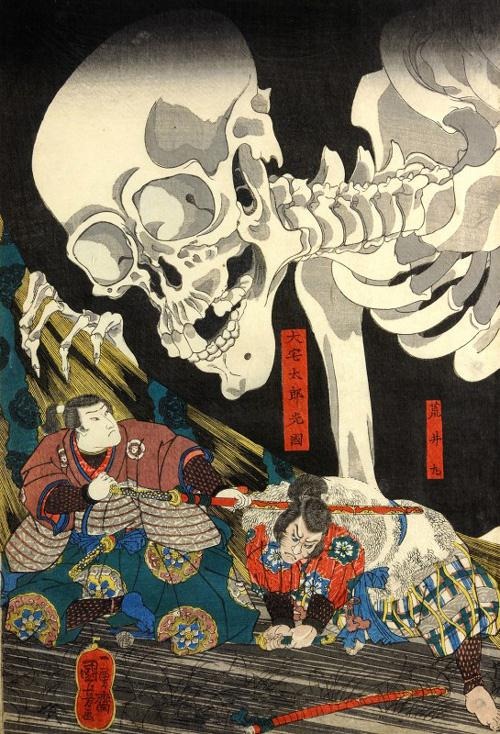
Mitsukuni [ Otaketaro ] defying the skeleton-spectre in the castle Soma no furugosho.Mitsukuni was a principal retainer of Taira no Masakado. After his death his daughter, Takiyasha, went to live in the haunted castle. She was able to summon up the apparitions at will, but the old servant, Mitsukuni, had the ability to defy them until they disappeared.detail,1845
[must see whole woodblock @ OTB or here ]
more warriors and legendsthanks to frenchtwist for reminding me of studio-international
twt.fm / stephane pompougnac -- "sunday drive" Sunday Drv
Download Song: Amazon | iTunes

hamidandco
hamid tekebaye


AP: John Boehner, Haley Barbour and Mike Pence
Mike Pence has quit his position as House Republican Conference chairman -- the No. 3 position in Republican leadership -- in order to begin his campaign for president. Yep, Mike Pence, from Indiana. That guy.
Oh, he may settle for governor, but I really hope he makes a presidential run, because, really, the only thing Democrats have to look forward to right now is a bunch of unlikable old white Republicans suddenly deciding that this election was actually decisive proof that voters love them, personally.
Pence thrilled the Values Voters Summit, the annual gathering of the sort of Republicans that make Americans hate Republicans, and he won their straw poll -- like Mike Huckabee before him.
(Even better: Michele Bachmann, who's great for fundraising but really not that great at appealing to anyone who doesn't read Big Government, wants to replace Pence in the House leadership.)
Everyone remembers John Boehner crying last night, and while he's a guy who just enjoys a good public cry every now and again, it did show that he interpreted the results as an endorsement of the governing philosophy and inspirational biography of John Boehner, leathery country club Republican and eventual leader of one-half of America's least favorite governing institution. With a small army of new Michele Bachmanns to corral -- and with no inclination to engage in "moderation" -- Boehner will soon be another interchangeable symbol of a "do-nothing Congress" engaged in "partisan bickering."
Haley Barbour, portly good ol' boy and contemporary Confederate, already thought he could be president. Today he probably thinks he could be president of the whole Union.
The Democrats who won in the last couple of cycles were so terrified of committing the "overreach" that they were destined to be accused of no matter what that they punted even on surefire winners like raising taxes on the rich -- but at least Nancy Pelosi ran the House to maximize accomplishments, not to burnish her personal brand. A bunch of emboldened Republicans who think the nation loves them for them ought to at least make for good entertainment while the nation eases itself back into the ditch.


