Sunday, November 28, 2010

Constantin Brâncuşi 1876 -1957, french, romainian born

Repost from 2007 -- had to fix the Flash anyway.

Trained originally as a Carpenter in Romania. Brancusi can be considered the first modern sculptor.In 2004, a sculpture by Brâncuşi named "Danaide" sold for $18.1 million, the highest that a sculpture piece had ever sold for at auction. In May 2005, a piece from the "Bird in Space" series broke that record, selling for $27.5 million in a Christie's auction.

m


i
Art Institute of Chicago Collection Database NEW!
12 works by Constantin Brancusi online

Dallas Museum of Art, Texas NEW!
Beginning of the World, ca.1920
The Sleeping Muse, ca.1910

Guggenheim Museum, New York City

J. Paul Getty Museum, Los Angeles
Article on the conservation difficulties presented by Brancusi's The Infinite Column


Constantin Brancusi at the Metropolitan Museum of Art, New York City
Bird in Space, 1923 (Zoom)


Metropolitan Museum of Art Timetable of Art History, New York City
Bird in Space, 1923

Museum of Fine Arts, Houston, Texas
(Zoomify viewer requires Java in order to view images)

A Muse, 1917

Museum of Modern Art, New York City
12 works by Constantin Brancusi online

Constantin Brancusi at the National Gallery of Art, Washington D.C.
Woman's Head, ca.1910

National Gallery of Australia, Canberra
2 works by Brancusi

4th Amendment Wear - Josh Spear

4th Amendment Wear
Thursday, 11.25.10

4th amnd1

4th amn 2

4th amn 3

Now there’s a way to protest those intrusive TSA X-ray scanners without saying a word. Announcing 4th Amendment Metallic ink-printed undershirts and underwear! Via Fubiz

4th Amendment Wear - Josh Spear, Trendspotting

Sunday, November 21, 2010

The Smart Set: A Queer Thing

smart set


ohara[6]Gayness was invented in America. That’s the thought that slowly formed in my mind while perusing the show “Hide/Seek: Difference and Desire in American Portraiture” at the National Portrait Gallery in D.C. I’m not saying that America invented homosexuality, of course. That goes a little further back. What America did was to give gayness its specific difference, to make “gay” into an identity you could have publicly like any other.


"Hike/Seek: Difference and Desire in American Portraiture" Through February 13, 2001. National Portrait Gallery, Washington, D.C.


“Hide/Seek” begins its American story, as is appropriate, with Walt Whitman. Walt was, after all, the great bard of American self-invention. If there was a new identity to be tried, Walt was ready to sing its praises. It has been speculated that Whitman had a more than passing interest in homosexuality. The manuscript version of his poem “Once I Pass'd Through A Populous City” contains the following lines:


Day by day and night by night we were together — all else has long been forgotten by me,
I remember I saw only that man who passionately clung to me,
Again we wander, we love, we separate again,
Again he holds me by the hand, I must not go,
I see him close beside me with silent lips sad and tremulous.

It is never clear in Whitman exactly how much he is attracted to men as men, and how much he is simply attracted to everyone and everything. Whitman’s sexuality is so overflowing as to be beyond any specific identity. One gets the feeling that Whitman got the same amount of erotic charge rubbing up against things in his kitchen as he did getting close to human beings. That is part of his overall metaphysics of joy and abundance.
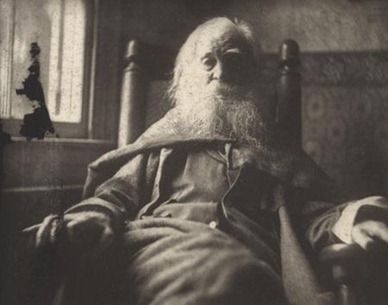

ahitman

Up through the early part of the 20th century, the Whitman approach to sexuality provided something of a safe haven for homosexuality. When everyone is being natural and happy and naïve, there is less need to ask specific questions. A painting in the show, “River Front No. 1” by George Wesley Bellows (1915), captures this attitude well. A bunch of guys are hanging out on the riverfront. There are all kinds of guys. Some of them have their clothes off, some don’t. There is a vague hedonism to the scene, but it is hard to place. It is not a gay scene exactly, or is it?
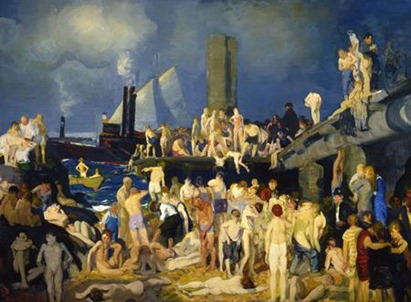

bellows

But it was this Whitmanesque fluidity and openness that had to be abandoned for a truly specific gay identity to emerge. Questions had to asked, identities had to be sorted out. There was a feeling, even maybe among gays themselves, that the ambiguity of the Whitman approach still glossed over a lie. A grand polymorphous panamorism might be nice as a poetic fantasy, but it did not address the problems faced by those who found themselves attracted to and falling in love with members of their own sex.

The Whitman ambiguity, however, lingered on into the period between the two World Wars. A 1930 photo of Lincoln Kirstein by Walker Evans for example, is a beautiful shot of a brooding young man. Is it also about being gay? We are not sure. The participants aren’t sure. There is no category, yet, through which that specific identity can find its voice.
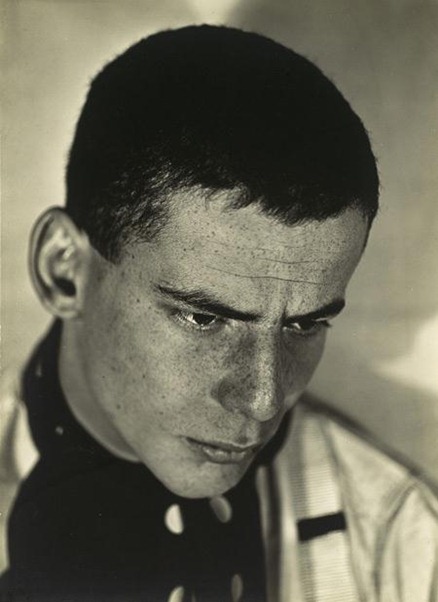

kirstein

Wednesday, November 17, 2010

The Majestic World of Molecular Animation - from GOOD

biology

Boing Boing just posted "Powering the Cell: Mitochondria," a visual feast of molecular animation produced by the BioVisions program at Harvard's Department of Molecular and Cellular Biology. The eye-catching journey into the complex world inside our bodies is BioVision's most recent contribution to the emerging molecular animation field, which is led by Harvard biologist-turned-animator Janet Iwasa, professor and director of life sciences Robert Lue, and biologist/director Drew Berry, all of whom are profiled in the recent New York Times article "Where Cinema and Biology Meet."

More:  Video: The Majestic World of Molecular Animation - Technology - GOOD

Saturday, November 13, 2010

ACLU calls on Att’y General to investigate Bush for Torturing | Informed Comment

Official photograph portrait of former U.S. Pr...

The American Civil Liberties Union is calling upon the Attorney General to look into prosecuting George W. Bush now that the latter has admitted to authorizing torture (i.e. waterboarding) at Guantanamo.

British officials have have denied Bush’s allegation that torture techniques yielded information that foiled terror plots in the UK.

Aljazeera English has a video report, which in part blames Alan Dershowitz for helping create an atmosphere in which the Bush administration could pursue this path:

Waterboarding is torture both in the US federal code and as recognized by decades of customary practice in the US.

Here is the US law on torture:

‘ (1) “torture” means an act committed by a person acting under the color of law specifically intended to inflict severe physical or mental pain or suffering (other than pain or suffering incidental to lawful sanctions) upon another person within his custody or physical control;


2) “severe mental pain or suffering” means the prolonged mental harm caused by or resulting from—

(A) the intentional infliction or threatened infliction of severe physical pain or suffering;

(B) the administration or application, or threatened administration or application, of mind-altering substances or other procedures calculated to disrupt profoundly the senses or the personality;

(C) the threat of imminent death; or

(D) the threat that another person will imminently be subjected to death, severe physical pain or suffering, or the administration or application of mind-altering substances or other procedures calculated to disrupt profoundly the senses or personality…’

The framers of the law on torture clearly could just not imagine that US politicians would order it while they are still in this country:

‘ (a) Offense.— Whoever outside the United States commits or attempts to commit torture shall be fined under this title or imprisoned not more than 20 years, or both, and if death results to any person from conduct prohibited by this subsection, shall be punished by death or imprisoned for any term of years or for life.

(b) Jurisdiction.— There is jurisdiction over the activity prohibited in subsection (a) if—

(1) the alleged offender is a national of the United States; or

(2) the alleged offender is present in the United States, irrespective of the nationality of the victim or alleged offender.

(c) Conspiracy.— A person who conspires to commit an offense under this section shall be subject to the same penalties (other than the penalty of death) as the penalties prescribed for the offense, the commission of which was the object of the conspiracy. ‘

If I were Bush, I wouldn’t vacation in Barcelona.

ACLU calls on Att’y General to investigate Bush for Torturing | Informed Comment

Strong, Colorful Surreal Paintings by Philemona Williamson at June Kelly Gallery


philemona
Philemona Williamson, Sunday Picnic, 2010. Oil on linen, 48 x 60 inches. Photo: Courtesy June Kelly Gallery.

NEW YORK, NY.- Fractured Tales, an exhibition of new paintings by Philemona Williamson — strong, colorful surreal narratives that both unsettle and delight -- opened at the June Kelly Gallery, on November 12. The exhibition will remain on view until December 14.
Williamson injects the edginess of imagination, memory and mystery in her examination of life stages between adolescence and adulthood. She brings intrigue into the daily human drama of searching for identity and constancy, and her figures abound with restless energy and uncertainty.

Strong, Colorful Surreal Paintings by Philemona Williamson at June Kelly Gallery

Monday, November 8, 2010